


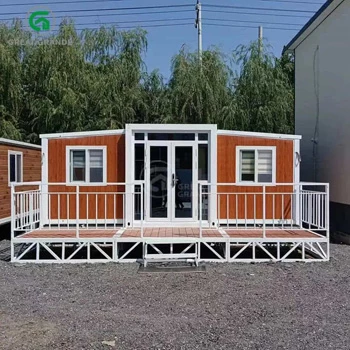
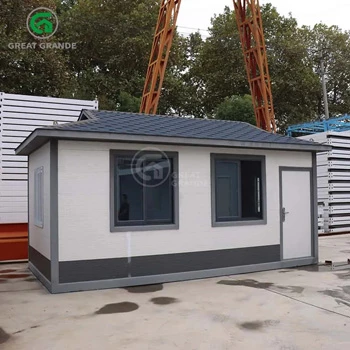
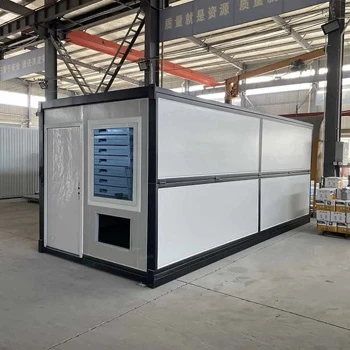


A 40ft High Cube (40HQ) container can transport 10-12 sets of folding houses or 1-4 sets of expandable houses. Both models are designed to be folded into a compact state for sea freight, allowing for high-density loading and easy unloading. Visual loading and unloading guides are available on our YouTube channel for operational reference.
In the modular housing industry, shipping costs can often exceed the cost of the unit itself if not managed correctly. The folding house and expandable house were engineered specifically to solve this logistical nightmare. By collapsing these structures into a fraction of their expanded size, we can utilize standard shipping containers for global transport. This guide breaks down exactly how many units fit into a 40 ft High Cube (40HQ) container and how to handle the unloading process.
Precision Packaging: Maximizing the 40HQ Interior
To understand the loading capacity, we must first look at the “workspace” provided by a standard 40HQ shipping container:
- Internal Length: 12.03 m
- Internal Width: 2.35 m
- Internal Height: 2.69 m
1. Folding House (Standard 20ft Model)
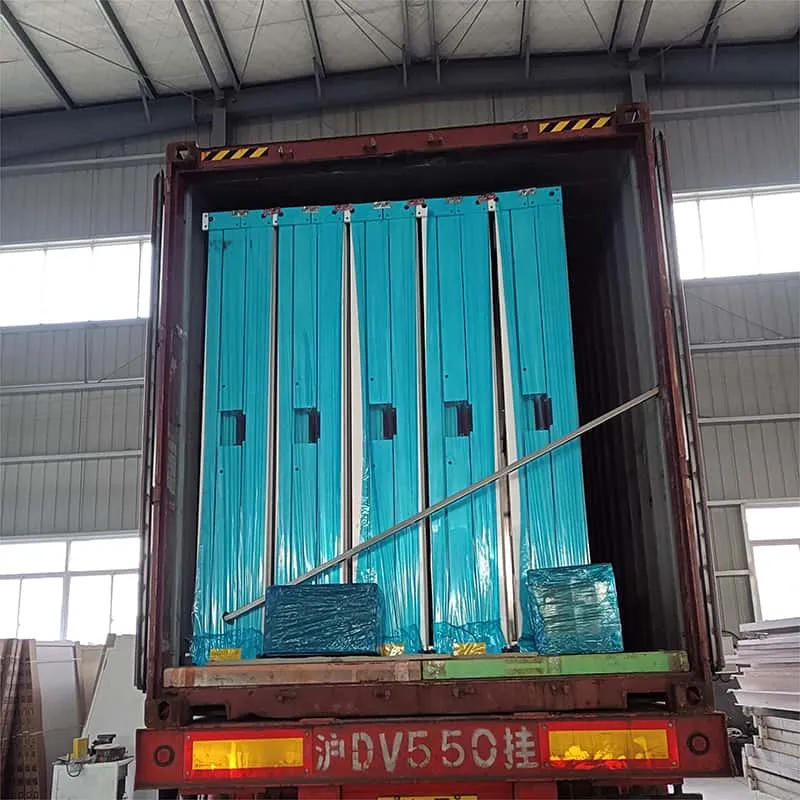
The folding house is the champion of space optimization. When collapsed, its dimensions are a precise 5800 x 2500 x 360 mm. At only 360 mm (approx. 14 inches) thick, these units are stacked vertically within the 40HQ.
2. Expandable House (10ft, 20ft, and 40ft Models)
The expandable house (double-wing) features a fixed central core (often containing the bathroom/kitchen) with wings that fold inward. Because the core is rigid, the loading capacity depends heavily on the unit’s length.
Loading Capacity Matrix (40HQ Container)
The following table outlines the loading efficiency for our primary modular models:
| House Type | Unit Length | Folded Dimensions (L x W x H) | Units per 40HQ |
| Folding House | 20 ft (Standard) | 5800 x 2500 x 360 mm | 10/12 Sets |
| Expandable House | 10 ft | Varies | 4 Sets |
| Expandable House | 20 ft | Varies | 2 Sets |
| Expandable House | 40 ft | Varies | 1 Set |
Unloading & Operational Safety
Unloading modular units requires precision to avoid damaging the hinges or the galvanized frame.
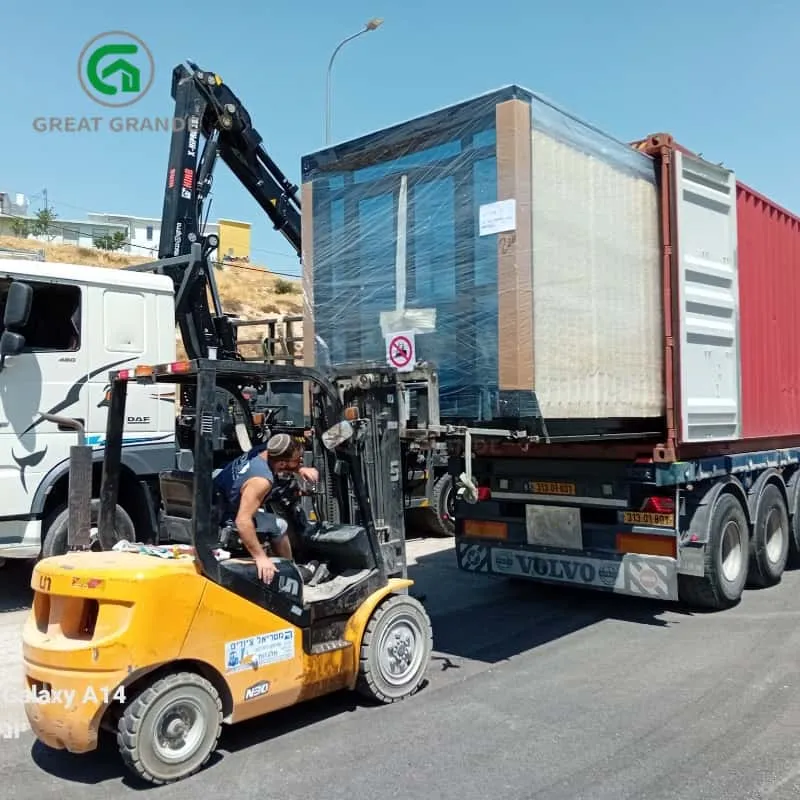
- Recommended Tool: A 3-ton forklift is the minimum requirement for safe unloading.
- Method: For folding houses, the forklift enters the 40HQ to pull the stacked “bundles” out. For expandable houses, the forklift must balance the central core weight.
Visual Guides (YouTube)
To see these processes in action, we have provided two essential video tutorials:
Loading/Unloading Folding Containers: Watch here
Unloading Expandable Houses: Watch here
Frequently Asked Questions (FAQ)
Why can a 40HQ fit 12 folding houses but only 2 expandable houses?
A folding house collapses into a flat “pancake” (360mm thick), allowing for dense stacking. An expandable house has a central core that remains at full height and width even when folded, which occupies significantly more volume.
Is there a risk of the houses shifting during sea transit?
No. Each unit is secured with high-tensile steel strapping and corner protectors. Since they fit snugly within the 12.03m length of the 40HQ, there is minimal room for movement.
Can I unload these without a forklift?
It is not recommended. Each unit weighs approximately 1.1 tons (for folding) to 2.5+ tons (for expandable). A 3-ton forklift is the safest and most efficient way to handle the arrival.
The folding house and expandable house are the most logistics-friendly housing solutions on the market today. By packing up to 12 units in a single 40HQ, we reduce the sea freight cost per unit by nearly 90% compared to shipping pre-assembled containers. Whether you are scaling a construction site or deploying rapid disaster relief, our foldable technology ensures your project remains within budget.